Agriculture has always been driven by observation: checking soil by hand, watching the sky for weather shifts, walking fields to assess crop health. But in an era of climate volatility, shrinking arable land, and rising food demand, observation alone is no longer enough. IoT in agriculture is closing that gap, giving farmers, agribusinesses, and agricultural enterprises the real-time data and automation they need to farm with precision, speed, and confidence.
Whether you are a farmer managing hundreds of acres, an AgriTech investor evaluating scalable solutions, or an IT manager building smart infrastructure for an agricultural operation, understanding how IoT works in agriculture and what it actually delivers is essential.
What Is IoT in Agriculture?
IoT or the Internet of Things, connects physical devices to the internet, enabling them to collect, transmit, and act on data without manual input. In agriculture, this means sensors, drones, vehicles, and monitoring systems across a farm can communicate with each other and with the farmer, in real time, from anywhere.
Smart agriculture built on IoT brings together sensor networks, big data analytics, autonomous machinery, and predictive modelling into one connected ecosystem. The result is a farm that does not just react to problems but anticipates and prevents them.
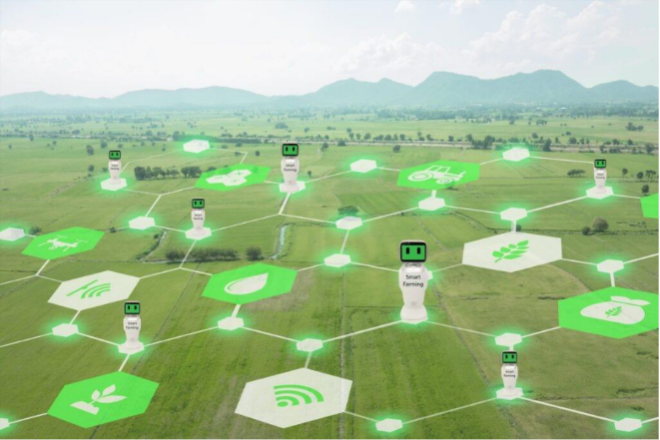
IoT in agriculture: smart farming sensor network connected across green farmland fields
Core Applications of Smart Farming Technology
Crop and Soil Monitoring
Soil sensors measure moisture, temperature, electrical conductivity (EC), and nutrient levels continuously. Farmers receive actionable insights on when to irrigate, how much fertilizer to apply, and which areas of a field need attention, without walking every row.
Livestock Health Tracking
IoT devices monitor individual animal health, feeding patterns, and movement. During lambing or calving seasons, for example, connected sensors can alert farmers to animals that need attention, replacing guesswork with data.
Smart Irrigation and Fertilization
Demand-based irrigation systems use real-time soil and weather data to apply water only where and when it is needed. This eliminates over-irrigation, reduces water waste significantly, and cuts input costs.
Drones and Autonomous Vehicles
Drones equipped with gyroscope and image sensors provide aerial field health monitoring, geo-mapping, and land analytics. Autonomous vehicles handle irrigation runs, spraying, and harvesting, reducing labour requirements and increasing consistency.
Connected Greenhouses and Hydroponics
Smart closed-cycle systems control temperature, humidity, CO2 levels, and light with precision. These systems make it possible to grow food in non-traditional environments: supermarket rooftops, urban containers, vertical farms, and more, effectively shortening the food supply chain.
Predictive Modelling
By combining data from diverse sensors over time, IoT platforms build crop models that predict how yields will respond to changing conditions. Farmers can test scenarios before committing resources, making planning far more reliable.
Why IoT in Agriculture Matters Right Now
Today’s agribusinesses are operating under serious pressure. Soil quality is declining. Usable land is shrinking. Weather patterns are increasingly unpredictable. Meanwhile, global food demand continues to climb.
IoT in agriculture addresses these pressures directly:
Efficiency at scale
Real-time monitoring means faster decisions. Farmers identify problems before they escalate, and automation handles routine tasks that previously consumed hours of labour each day.
Resource optimisation
Precision farming with IoT ensures water, energy, land, pesticides, and fertilizers are used only as needed. This reduces input costs, minimises environmental impact, and produces cleaner, more organic end products compared to conventional methods.
Agility in extreme conditions
Connected monitoring systems track weather shifts, soil changes, and crop health simultaneously. When conditions change rapidly, farmers and agribusiness managers can respond within hours rather than days.
Better product quality
Understanding the relationship between environmental conditions and crop outcomes allows producers to recreate optimal growing conditions consistently, improving both yield and nutritional value.
IoT Sensors Driving Precision Agriculture
The foundation of any smart farming system is its sensor network. Common IoT agriculture sensors include:
- Moisture and Temperature Sensors for automated irrigation management and climate control in storage and growing facilities.
- Near-Infrared (NIR) and EC Sensors used in portable soil scanners that deliver real-time diagnostics and fertilizing recommendations directly to a farmer’s phone.
- Gyroscope and Image Sensors fitted to drones and autonomous vehicles for field mapping, crop health imaging, and autonomous operations.
- Environmental Sensors including CO2, light, solar energy, air temperature, and humidity sensors that feed data into farm management platforms continuously.
- Together, these sensors give farmers a complete, dynamic picture of their operation, from individual plant health to whole-farm performance.
Overcoming IoT Challenges in Agriculture
Despite its advantages, deploying IoT in agriculture comes with real technical challenges.
- Connectivity is the most significant hurdle. Agricultural environments span large open spaces, remote fields, and infrastructure-poor areas. A reliable, uninterrupted connection is essential for an IoT system to function correctly, and it must hold up against severe weather and distance. In Ireland, connectivity infrastructure is addressed through the Sigfox network, which covers 99% of the island using antennae on RTE radio masts. This makes outdoor IoT deployment viable even in remote farming regions, without relying on mobile data coverage.
- Durability is equally important. IoT devices used in agriculture must withstand dust, rain, temperature extremes, and rough handling. Rugged device design ensures sensors and trackers remain operational in tough conditions. Mobile solutions attached to shipping containers and agricultural vehicles are built to handle varied environments, with some models featuring replaceable batteries that extend device life to over five years in the field.
- Integration complexity is a challenge for larger operations. Connecting sensors, platforms, analytics tools, and farm management software into one coherent system requires expertise in both IoT architecture and agricultural operations.
How Yes Dynamic Supports IoT Implementation in Agribusiness
Deploying IoT in agriculture is not just a technology purchase. It requires the right strategy, infrastructure, integration, and ongoing support to deliver real value. That is where Yes Dynamic comes in.
Yes Dynamic is a full IoT implementation partner for agribusinesses, covering everything from initial consulting and system design to deployment, integration, and long-term support. Whether you are building a precision farming setup from scratch, upgrading an existing operation with smart sensors, or integrating IoT data into your farm management systems, Yes Dynamic brings both the technical capability and the sector understanding to make it work.
The goal is not just connectivity. It is turning data into decisions that improve yield, reduce costs, and build a more sustainable agricultural operation.
The Future of Smart Agriculture
IoT in agriculture is not a future trend. It is an active transformation happening across farms, greenhouses, and agribusinesses globally. As climate pressures intensify and the demand for sustainable food production grows, the farms that will thrive are those that use data as a competitive advantage.
For farmers ready to act on gut instinct backed by real numbers, for investors looking at scalable AgriTech opportunities, and for IT managers building the infrastructure of modern agriculture, IoT is the foundation that makes it all possible.
If you are ready to explore what IoT implementation looks like for your operation, Yes Dynamic is ready to help you build it. Contact us today.